Industrial Symbiosis and Common Misconceptions
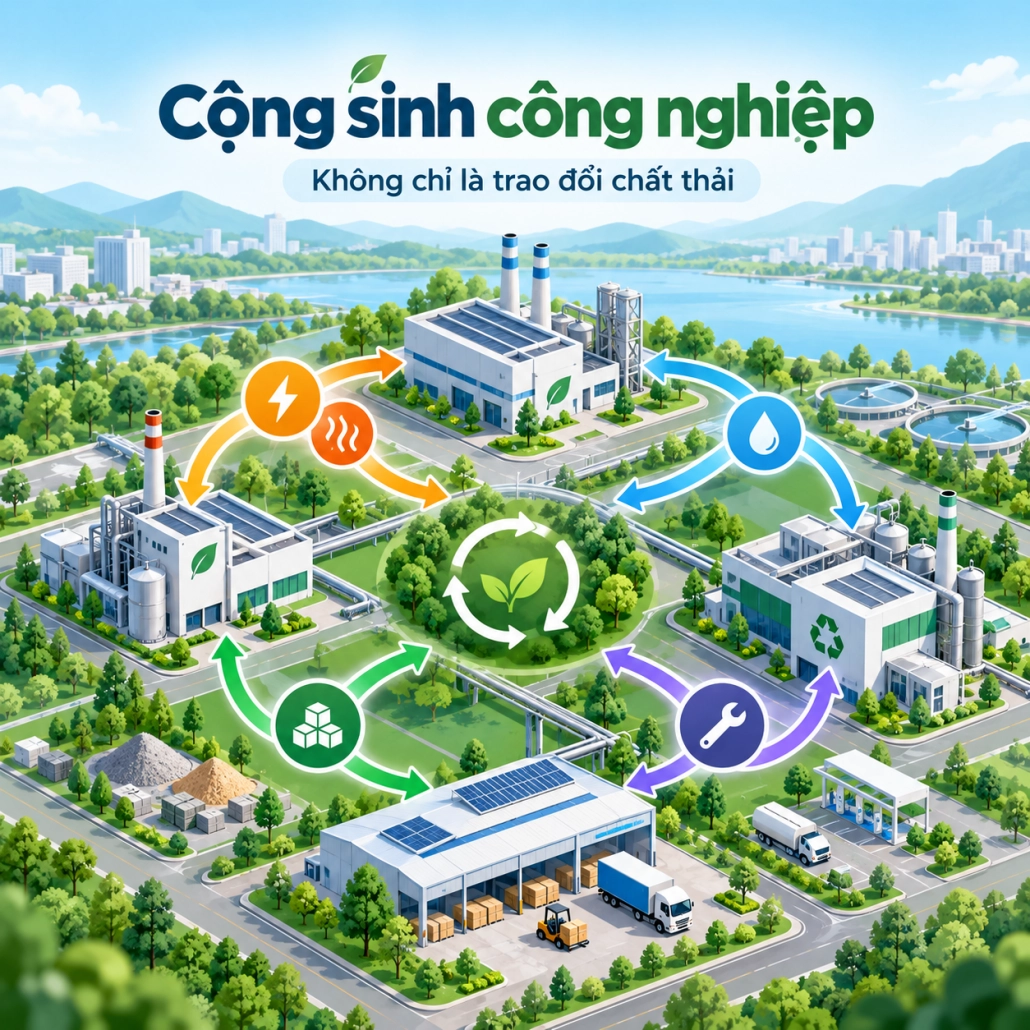
When industrial symbiosis is mentioned, many people simply think of waste from one enterprise being transferred to another for use as production input. However, this is only one of the three groups of industrial symbiosis activities defined under Vietnamese regulations. From an international perspective, industrial symbiosis is considered in a much broader range of forms.
So, what is industrial symbiosis, what forms can it take, and what criteria can be used to determine whether a collaborative activity qualifies as industrial symbiosis?
Industrial symbiosis is more than just waste exchange
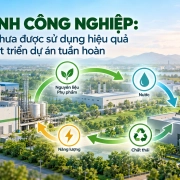
According to Clause 7, Article 2 of Decree No. 35/2022/ND-CP, industrial symbiosis refers to cooperation between enterprises within an industrial park (IP) or across different IPs to optimize the use or reuse of inputs and outputs such as raw materials, materials, water, energy, waste, scrap and other factors arising from production and business activities.
According to Clause 1, Article 2 of Circular No. 05/2025/TT-BKHDT, industrial symbiosis includes three groups of collaborative activities:
- Exchange of inputs and outputs: Enterprises cooperate in exchanging raw materials, materials, water, energy, waste, scrap and other factors arising from production and business activities, in compliance with environmental protection regulations.
- Shared use of production infrastructure: Enterprises cooperate in using infrastructure provided by the participating parties or by a third party, excluding common technical and social infrastructure of the industrial park provided by the industrial park infrastructure developer.
- Shared use of production and business services: Enterprises cooperate in using services provided by participating parties or by a third party, such as equipment maintenance, warehousing or employee training.
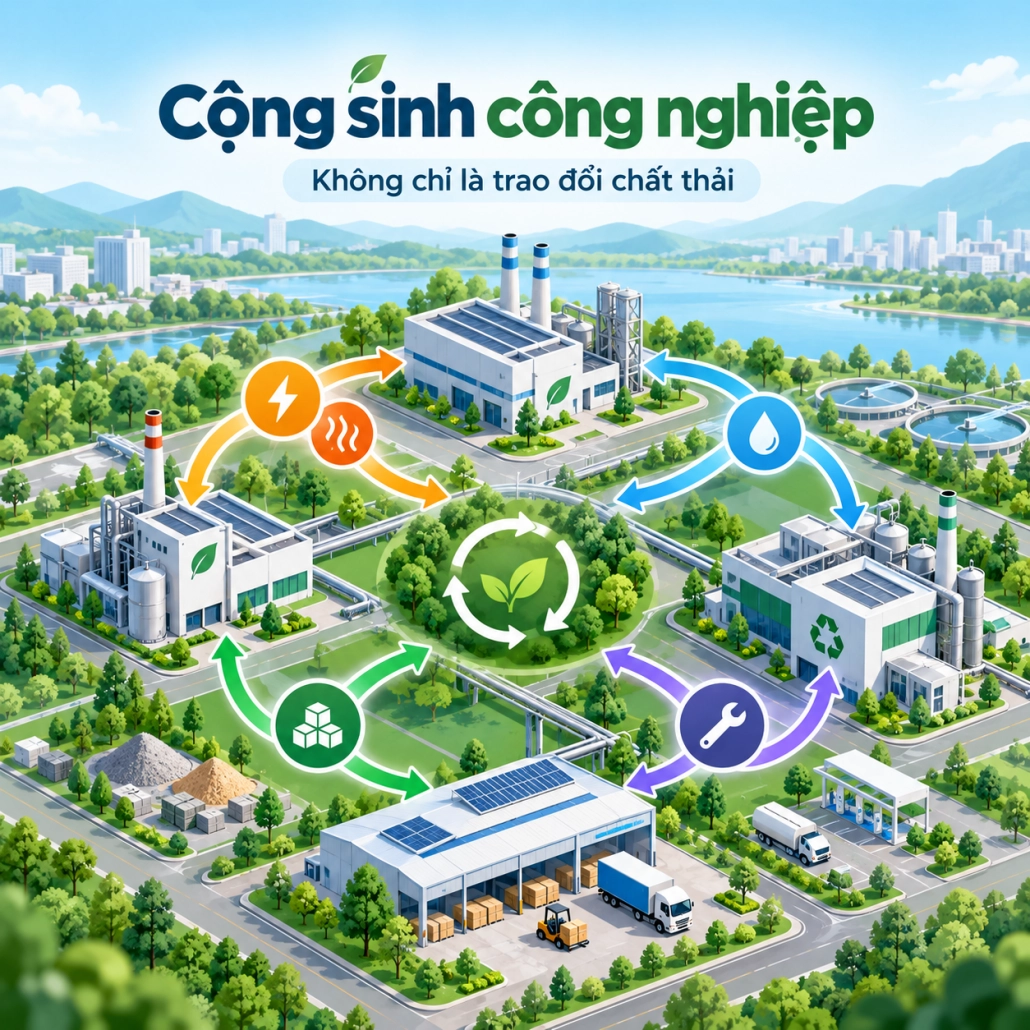
From an international perspective, guidance documents on eco-industrial parks developed by the United Nations Industrial Development Organization (UNIDO) also refer to five forms of industrial linkages, including:
- Utility symbiosis and infrastructure sharing;
- By-product symbiosis and waste exchange;
- Service symbiosis;
- Supply-chain symbiosis and enterprise co-location;
- Industrial-urban symbiosis.
Industrial symbiosis is therefore not limited to waste exchange, but encompasses a wide range of collaborative arrangements aimed at optimizing resource use among enterprises.
Not every waste transaction constitutes industrial symbiosis
Suppose Enterprise A transfers or sells scrap to Enterprise B for use as an input material. If the relationship is merely a conventional purchase-and-sale transaction, without coordination aimed at optimizing resource use, there may not yet be sufficient basis to classify it as an industrial symbiosis linkage.
What forms can industrial symbiosis take, and what criteria can be used to determine whether a collaborative activity qualifies as industrial symbiosis?
To identify and demonstrate that such cooperation constitutes industrial symbiosis, the following factors should be considered:
- A clear and transparent cooperation mechanism: Agreements, contracts, memoranda of understanding or other relevant documents should demonstrate the cooperation between the parties and clearly define their rights and obligations, technical requirements for exchanged material flows, and mechanisms for allocating responsibilities and risks.
- Resource-use efficiency: The cooperation should demonstrate the potential to utilize waste or by-products from Enterprise A as substitutes for input materials used by Enterprise B, thereby identifying the quantities of raw materials, water, energy or other resources that are saved, reused or used more efficiently.
- Measurable environmental benefits: The reduction in waste requiring treatment, greenhouse gas emissions and other environmental impacts resulting from the cooperation should be identified, while ensuring that pollution is not merely transferred from one enterprise to another.
- Economic benefits for participating parties: The economic benefits generated should be clarified, such as lower waste treatment costs for Enterprise A and reduced input material or operating costs for Enterprise B.
- Positive social and community impacts: The cooperation should ensure occupational safety and health for workers, minimize risks to surrounding communities, and consider its potential to create additional employment and social value.
These benefits should be assessed, quantified and demonstrated through appropriate data and documentation in order to determine their actual effectiveness and provide a basis for monitoring implementation results. At the same time, industrial symbiosis activities must comply with relevant legal requirements, particularly environmental protection regulations governing the exchange, transfer and use of waste and scrap.
The value of industrial symbiosis lies in cooperation
Industrial symbiosis is not simply about attaching a new label to transactions between enterprises. Rather, it represents a shift from individual optimization toward resource optimization through cooperation.
Therefore, when identifying an industrial symbiosis opportunity, the question should not only be: “What can Enterprise A provide to Enterprise B?”
More importantly, the questions should be: “How can the enterprises cooperate, how can resources be used more efficiently, and what environmental, economic and social benefits can the cooperation generate?”
Correctly identifying the nature, forms and value of industrial symbiosis provides a foundation for enterprises to establish appropriate linkages, thereby contributing to the transformation of industrial parks toward eco-industrial development and sustainable growth.
VNCPC