What is ESG? Why are businesses increasingly paying attention to ESG?
As sustainable development becomes an inevitable trend, ESG is increasingly discussed in production, business and corporate governance. Beyond investors and financial institutions, customers, supply chain partners and consumers are paying growing attention to how enterprises fulfil their environmental, social and governance responsibilities.
However, for many Vietnamese enterprises, especially small and medium-sized enterprises, ESG remains a relatively new concept. What exactly is ESG? Why should enterprises care about it, and where should they start?
What is ESG?
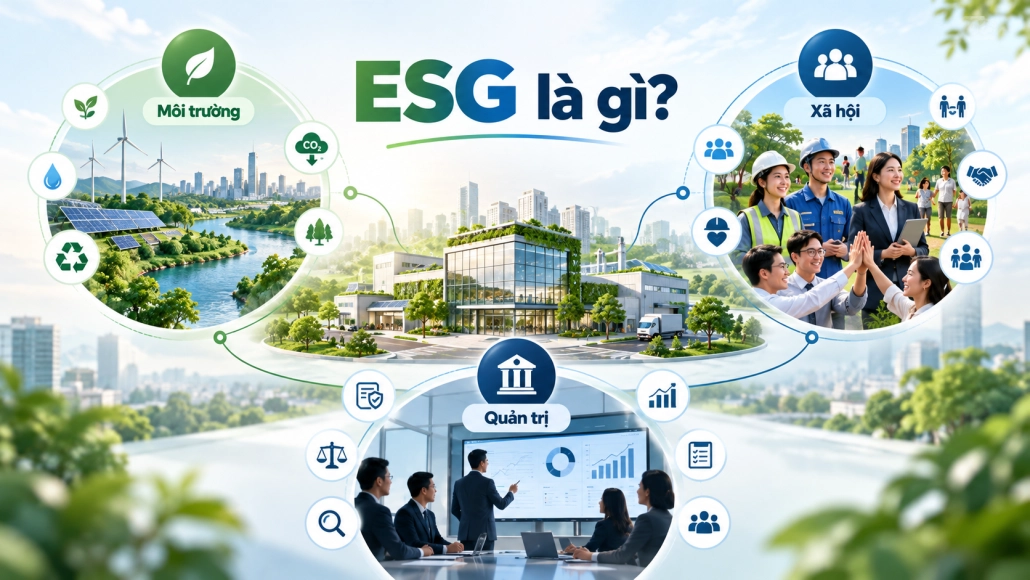
ESG stands for three factors: Environmental (E), Social (S) and Governance (G). It is an approach that helps enterprises identify, assess and manage the impacts, risks and opportunities related to sustainable development in their operations.
The concept of ESG is rooted in ideas of corporate social responsibility and became widely known through the United Nations’ Who Cares Wins initiative in the 2000s. Having started mainly as a tool for investment assessment, ESG has increasingly become an important element of corporate development strategy and governance.
The three pillars of ESG are:
E – Environmental: The impact of production and business activities on the environment, such as the use of energy, water and materials; waste management; pollution control; greenhouse gas emission reduction; climate change response and the promotion of the circular economy.
S – Social: The enterprise’s responsibility towards employees, customers, suppliers and the community. Key topics include working conditions, occupational health and safety, employee rights, equality, supply chain responsibility and community contribution.
G – Governance: The enterprise’s organisational structure, management mechanisms, transparency and accountability. This pillar covers legal compliance, business ethics, anti-corruption, risk management, information disclosure and data protection.
The three pillars are closely linked and complement each other, helping enterprises develop stably and sustainably in the long term.
ESG is neither entirely new nor separate from day-to-day production and business activities.
Is ESG really unfamiliar to enterprises?
When ESG is mentioned, many enterprises immediately think of international standards, complex indicator systems or sustainability reports that require significant resources.
However, ESG is neither entirely new nor separate from day-to-day production and business activities.
In practice, many ESG topics are already present in enterprises. Saving electricity, using water efficiently, reducing material consumption, controlling waste and improving working conditions are all linked to environmental and social factors. Likewise, fully meeting legal obligations, ensuring transparency in management and building internal control procedures belong to the governance pillar.
What makes an ESG approach different is that enterprises look at these activities holistically and systematically, link them to specific goals, and measure, monitor and improve them over time.
In other words, implementing ESG does not necessarily have to start with major changes or costly investments; it can begin with identifying, assessing and improving the activities an enterprise is already carrying out.
Why is ESG becoming increasingly important?
Interest in ESG stems not only from the need to protect the environment or fulfil social responsibility, but is also directly linked to business operations, market access and competitiveness.
First, investors and financial institutions are paying more attention to risk and sustainability.
Alongside traditional financial indicators, ESG information gives investors, banks and financial institutions an additional basis for assessing risk management capacity, compliance and long-term prospects. ESG management capacity can therefore become a factor in investment or financing decisions.
Second, customers and partners are increasingly concerned with responsibility in the supply chain.
Enterprises in supply chains, especially international ones, may be asked to provide information on the origin of raw materials, energy consumption, greenhouse gas emissions, working conditions and environmental and social management measures.
These requirements mean that ESG is no longer an issue only for large enterprises; it can also affect small and medium-sized enterprises in their role as suppliers.
Third, consumers and communities are paying more attention to corporate responsibility.
Besides product quality and price, the way an enterprise protects the environment, treats its employees and fulfils its responsibility to the community can also influence consumer trust and choice.
In the digital media environment, issues related to the environment, labour or business ethics can quickly affect a brand’s image and reputation.
ESG therefore not only helps enterprises meet stakeholder expectations, but also creates opportunities to use resources more efficiently, improve risk management and strengthen competitive advantage.
Where should enterprises start with ESG?
For enterprises new to ESG, the first priority is not to choose a set of standards or develop an ESG report right away, but to understand their current operations clearly and identify the ESG issues that are truly relevant to them.
Enterprises can start by reviewing their management of the environment, energy, human resources, occupational safety, the supply chain and internal governance; identifying the data already available, the gaps that remain, and the requirements of customers, partners or financial institutions.
On that basis, enterprises can gradually select priority issues and set improvement goals and solutions that suit their size, sector, resources and development direction.
This approach makes ESG part of an enterprise’s management and improvement activities, rather than merely a documentation or reporting requirement.
Learn about ESG with VNCPC through a series of articles
To help enterprises and readers better understand ESG and its role in production, business and sustainable development, Vietnam Cleaner Production Center Co.Ltd. (VNCPC) will introduce a series of articles on ESG on its website.
The series will cover topics from basic to in-depth, including the concept and pillars of ESG; stakeholder requirements and expectations; how to identify ESG factors in business activities; assessing the current situation, identifying areas for improvement and selecting suitable implementation solutions.
With an easy-to-understand, practical approach grounded in real-world experience, VNCPC hopes the series will become a useful reference, helping enterprises gradually adopt ESG in their management, production and business, thereby improving resource efficiency and competitiveness and moving towards sustainable development.
We invite enterprises and readers to follow the upcoming articles in the ESG series on the VNCPC website for useful knowledge, information and solutions.
VNCPC