Product Life Cycle Assessment – An Optimal Solution for Sustainable Development
In the context of the global economy shifting strongly toward green and sustainable development, Life Cycle Assessment (LCA) has become a key tool that helps businesses demonstrate their environmental responsibility. LCA is not only a technical report, but also proof of a company’s efforts to optimize its production processes and supply chain.
What is LCA?
LCA (Life Cycle Assessment) is a method for assessing and measuring the environmental impacts associated with a product, service, or process throughout its entire life cycle. This process is carefully calculated from raw material extraction, production, and transportation to the time the product is used and finally treated or recycled.
Conducting LCA enables businesses to integrate sustainability information into management reports, helping enhance transparency and brand credibility with investors and consumers.
LCA stages and approaches
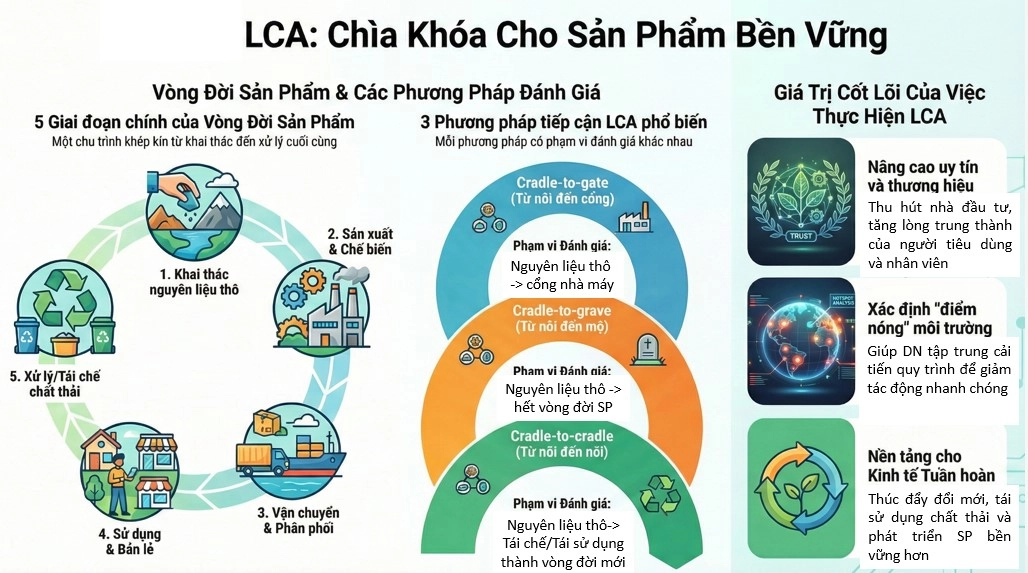
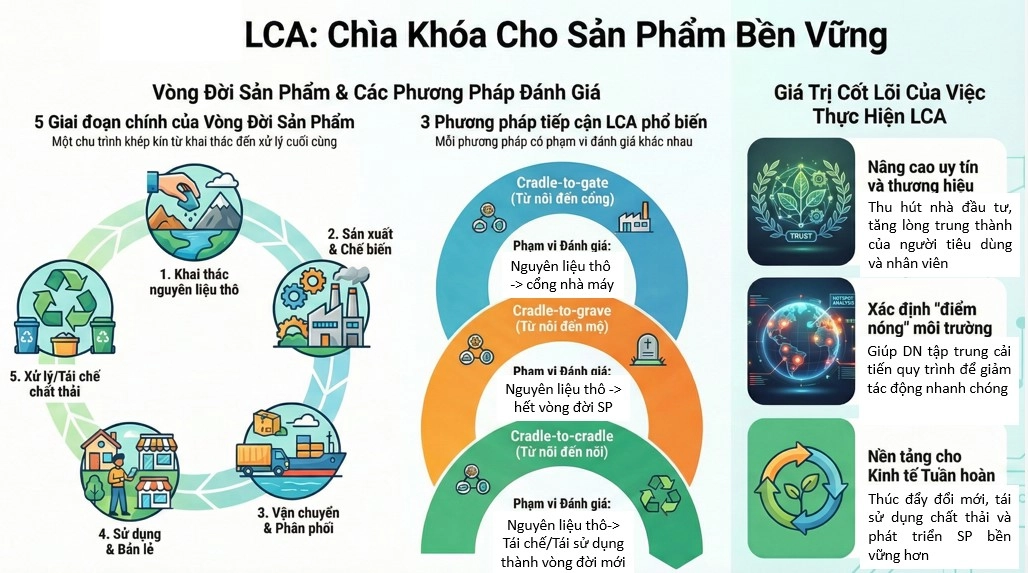
A typical product life cycle goes through five main steps:
- Raw material extraction.
- Production and processing.
- Transportation and distribution.
- Use and retail.
- Waste treatment or recycling.
Depending on the company’s objectives, different LCA approaches can be selected:
- Cradle-to-gate: Assessment from raw material extraction until the product leaves the factory.
- Cradle-to-grave: Comprehensive assessment from raw materials until the product reaches the end of its life cycle.
- Cradle-to-cradle: This is an approach that promotes the circular economy, assessing the product until it is recycled to begin a new life cycle.
ISO-standard LCA implementation process
Life cycle assessment is internationally standardized through the ISO 14000 series of standards. The two core standards include:
- ISO 14040:2006: Specifies the principles and general framework of LCA.
- ISO 14044:2006: Provides detailed requirements and guidelines for performing system modeling and reporting results.
A standard LCA study typically includes four closely connected phases:
Phase 1: Defining the goal and scope of the study.
Phase 2: Inventory analysis: Collecting input and output data of the system.
Phase 3: Impact assessment: Converting inventory data into specific environmental impacts.
Phase 4: Interpretation of results: Drawing conclusions and identifying opportunities for improvement
Outstanding benefits for businesses conducting LCA
Conducting LCA brings many strategic values rather than merely ensuring regulatory compliance:
Identifying “hotspots”: Helps businesses clearly know which stage causes the greatest environmental impact in order to prioritize improvements, thereby saving costs and reducing waste.
Expanding the scope of assessment: LCA does not stop at carbon emissions (GHG), but also measures impacts such as ozone depletion, land use, resource depletion, and water consumption.
Supporting marketing and design: Promotes the “Design for Environment (DfE)” strategy, helping products gain a competitive advantage and avoid the risks of “greenwashing”.
Attracting investment: In-depth LCA activities help improve ESG scores, leading to greater interest from investors and stronger customer loyalty.
Software tools supporting LCA
To conduct LCA accurately, businesses often use specialized software such as:
- SimaPro & GaBi: Suitable for many sectors, including manufacturing, energy, and automotive
- OpenLCA: A flexible open-source tool for waste management and construction
- OneClickLCA: Focuses specifically on environmental impact assessment in the construction sector
It can be seen that LCA is not merely a technical process for measuring environmental indicators, but has become a smart business strategy in the green era. Understanding all impacts from “cradle” to “grave” helps businesses not only comply with increasingly stringent international regulations, but also identify opportunities to optimize costs, minimize waste, and improve production processes effectively.
In a market where consumers and investors increasingly prioritize sustainable values, conducting LCA systematically is the clearest proof of a company’s responsibility. This is not only a tool for protecting the environment, but also a “guiding compass” that helps businesses enhance their brand, promote the circular economy, and build a solid competitive advantage in the international market
VNCPC