
UNIDO celebrates its 50th anniversary

Did you know that in Viet Nam, the net flow of foreign direct investment increased from USD1billion in 2003 to USD10 billion in 2008, and that by 2015 reached USD23 billion?  Or that the total value of exports rose from USD2 billion in 1990 to USD72 billion in 2010, to reach USD162 billion in 2015? These impressive figures highlight the country’s robust economic success, providing a boost to the economy and employment.

These accomplishments are largely due to the reforms undertaken by Viet Nam since Doi Moi in 1986 which liberalized the economy, attracted foreign investment, fostered exports and reduced poverty. To prepare for reform, Viet Nam received extensive technical assistance from the international community, including from the United Nations Industrial Development Organization (UNIDO), well before 1986 and, more precisely, since 1978.

For more than 35 years, UNIDO has been sharing international best practices to help Viet Nam develop inclusive and sustainable industry. With more than USD100 million in expenditure, UNIDO’s technical cooperation activities have been carried out across a broad range of fields, including support to the private sector and technical and industrial research organizations, facilitation of technology transfer, trade capacity-building, human resource development, environmental protection, energy efficiency, investment promotion and responsible business practices.

The aim of UNIDO’s programme is to assist the Government in achieving sustainable and equitable social and economic development. Multi-dimensional partnerships have been developed with Viet Nam’s ministries in charge of industry, trade, planning, investment, agriculture, science and technology, and the environment, and with the Chambers of Commerce and Industry, business associations, universities and UNIDO’s centres.

UNIDO has focused its assistance on the preparation and implementation of industrial and trade development strategies and policies, for example industrial sector surveys, industrial sub-sector policies, foreign and domestic investment policies and legislation. UNIDO has also improved the capacity of the General Statistical Office. Another aim has been to foster the development of local suppliers of professional services for industrial development, and strengthen the capacity of every kind of business association.

The mechanisms for technology transfer differ considerably between centrally-planned economies and market economies. In Viet Nam, UNIDO has acted as a catalyst, facilitator and initiator of the technology transfer process. Furthermore, UNIDO has facilitated contact between Vietnamese and foreign enterprises through technical exhibitions, seminars, investment promotion, and information networks.

On environmental issues, one priority area for UNIDO has been cleaner production and energy efficiency. UNIDO has supported country endeavours through policy advice, information on the availability and choice of clean technology, and promotional programmes, as well as environment and energy audits.

Human capital investments are prominent in virtually all the success stories of East Asia. Educational expenditure is fundamental but the private sector’s participation is also important. UNIDO-supported services can be classified in three categories: (i) assistance in preparing strategies, policies and plans for industrial human resource development; (ii) strengthening of institutional capacity for industrial human resource development (training of trainers); and (iii) training geared directly to groups of enterprises or industrial sub-sectors.

UNIDO has achieved outstanding project results in Viet Nam, and I would like to highlight just a few of them:

  • The UNIDO Viet Nam Cleaner Production Centre, which started its activities at the end of 1998, has served as a major driver of Viet Nam’s sustainable industrial production pathway.
  • UNIDO has supported Viet Nam’s pre-ratification assessment of the Minamata Convention to control mercury in products and avoid unnecessary health hazards to people and the environment.
  • To help the country address the challenge of reducing energy intensity, UNIDO has developed the first-ever comprehensive plan to institute measures for improving industrial energy-efficiency and conservation.
  • Viet Nam became the WTO’s 150th member in 2007, and since then UNIDO has helped Viet Nam to conform to international standards and win access to markets. Product quality and standard issues are one of the biggest challenges for Viet Nam’s international economic i
  • For over 15 years, UNIDO has been privileged to partner with the Government in the field of business registration reform. UNIDO’s assistance has addressed obstacles faced by entrepreneurs in completing start-up registration procedures. In particular, it helped with the implementation of the Enterprise Laws of 2005 and 2014 and the simplification of registration procedures. In 2010, the Agency for Business Registration was established and, in the same year, the National Business Registration System was launched. The data of 574,535 existing enterprises has been transferred and, as of December 2015, 477,235 new enterprises had been registered. The statutory time-limit for business registration has been reduced from 15 to just three days.

The recently agreed 2030 Agenda for Sustainable Development presents us with global and ambitious goals which address all three dimensions of sustainable development − economic, environmental and social. These goals and targets are also complemented by the Paris Agreement, adopted by 195 countries last December. This agreement – the first ever universal, legally binding global climate deal − commits us to limiting global temperature rise to well below two degrees Celsius above pre-industrial levels.

Sustainable Development Goal 9 of the 2030 Agenda recognizes the relevance of inclusive and sustainable industrialization for poverty eradication, and echoes UNIDO’s mandate of inclusive and sustainable industrial development. With regard to Viet Nam, UNIDO sees two major issues for the achievement of Sustainable Development Goal 9. Firstly, how can the recent trade liberalization and economic and productive restructuring benefit Vietnamese companies? Secondly, how can industrial policy and strategies be re-formulated to take account of national priorities, as well as of global threats and opportunities, including the building of linkages among industrial sectors to increase the manufacturing value added of existing products and to enter new and more dynamic sectors.

The current global setting is far different from that of the 1990s. Viet Nam is now part of a bigger game, from which it has passed the point of no return with the signing of key trade deals in 2015.  The Trans-Pacific Partnership (TPP) trade agreement holds considerable potential. Viet Nam could be the greatest beneficiary of the 13-nation deal, with a boost of Vietnam’s gross domestic product by as much as 8 per cent over the next two decades. The signing of another free trade agreement with the European Union will eliminate 99 per cent of tariffs on traded goods over a 10-year period.

Viet Nam is also likely to be a major partner of the new ASEAN Economic Community (AEC).The creation of the AEC, together with Viet Nam’s rise as an industrial and technological production centre, are expected to support higher levels of intra-bloc trade and investment.

In this new context, UNIDO will continue to work with Viet Nam to promote restructuring and modernization to enhance quality and competitiveness. We will focus on key industries and those industries having comparative advantages and strategic significance for fast, effective and sustainable development and the greater independence and self-reliance of the economy.

UNIDO is keen to support Viet Nam’s inclusive and sustainable industrial development strategy, and believes that, by 2035, Viet Nam’s economy will be inclusive, with a focus on women and youth, and with specialized industries meeting international standards in terms of technology and product quality, participating in the global value chain, using energy efficiently, and competing fairly in integrated global markets.


LI Yong

UNIDO Director General

Source: UNIDO Vietnam

Promoting sustainable pangasius market in Europe
In order to provide opportunities for the farmers, production and processing enterprises to learn about foreign fish market, the SUPA project ” Establishing a Sustainable Pangasius Supply Chain in Viet Nam” continues to support business delegation to participate in activities at the global seafood fair from May the 21st – 23 rd, 2015 in Brussels (Belgium).

The delegation includes representatives from organizations involving in the project: Vietnam Cleaner Production Centre (VNCPC), Vietnam Association of Seafood Exporters and Producers (VASEP), World Wildlife Fund in Vietnam (WWF- VN) and World Wildlife Fund in Austria (WWF- AT). In addition, there are representatives from 6 farming and processing enterprises and 1 representative from the farming cooperative in An Giang province.

1

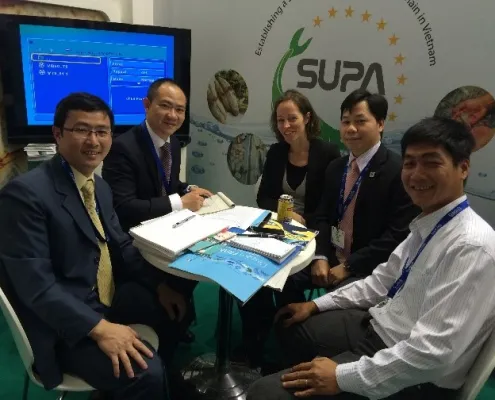
 The project partners are having discussion with pangasius importers in Europe

In 2014, the project also created favorable conditions for the business delegation to participate in the Fair, which helps them have a lot of new customers from Europe and some other countries. When participating in the event, the representatives from enterprises had chance to visit some supermarkets in Belgium to learn about the market and compare Vietnamese catfish products with other products under the guidance of foreign experts. Especially, one company has signed contract directly with a supermarket. This is the first time that a Vietnamese pangasius company has direct sale with a supermarkets without intermediate importers.

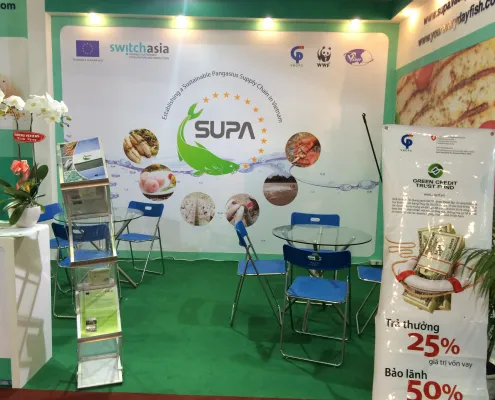
In this Fair, the enterprises have chance to see by their own eyes the fishery products of other countries in the world, the farming model with high quality together with all kinds of advanced machines and support equipment. Besides, the experience sharing and market connectivity also brought an added value for them. The SUPA project rented a fair booth to help promote information and it’s a destination for the dealers, importers and businesses enterprises to meet each other and exchange their experiences. In this booth, there are catalogues bag, brochures, and flyers for delivery, together with business certifications accompanied by CD disc about pangasius production and processing toward sustainable development, environmental friendliness.

2

Pangasius processing company is negotiating with the client

Attending the Fair, SUPA project, together with other partners like Center for the Promotion of Imports from the developing countries – CBI (Ministry of Foreign Affairs, Netherlands), VASEP and Directorate of Fisheries (MARD) held a Forum with title “International Business Forum to promote sustainable export for Vietnamese catfish”. Because it was taking place during the Fair time, the Forums drew great attention from international organizations such as WWF, the seafood certification agencies, importers and retailers from the Netherlands, Britain, France, Vietnamese catfish production and processing companies, the press agencies of Vietnam in Europe such as Vietnam Television, Vietnam News Agency. At this forum, Mr. Pham Anh Tuan, Deputy Director (General Directorate of Fisheries) has introduced the status quo of pangasius production and processing industry, the basic issues that need to be improved towards sustainable development, especially it’s the introduction of Decree No.36 for controlling and making transparency of information and improving the quality of Vietnamese catfish. Hereby, the importers, the retailers have better understanding about the commitment of Vietnamese Government for a sustainable catfish production in specific and seafood production in general.

Admin VNCPC

Young Vietnamese keen on adopting, sharing green lifestyle
A number of young Vietnamese joined a green tour on Saturday to Dong Nai Province, which neighbors Ho Chi Minh City, as one of GetGreen Vietnam’s activities to promote a green lifestyle and sustainable consumption.

1606772-ybjobrsu

The group went to Kingfisher Nest Tourism Complex in Vinh Cuu District

GetGreen Vietnam is a project promoting sustainable consumption in the country which focuses on sustainable living and working for middle-income consumers in urban areas, according to its website.

Like its sister project SPIN (Sustainable Product Innovation), GetGreen Vietnam is also co-funded by the SWITCH-Asia Program of the European Union and implemented by the Netherlands’ Delft University of Technology, Vietnam Cleaner Production Center, and the Asian Institute of Technology in Vietnam.

The project is aimed at developing consumption groups which are aged from 18 to 45 and include students or office workers in a sustainable consumer community and at launching campaigns to promote environmental protection and combat climate change.

The project costs a total of €1.4 million, of which 80 percent is funded by the SWITCH-Asia Program of the European Union, and 20 percent comes as corresponding funds from the project’s partners, its website added.

Its implementation time is three years from April 2012.

A social network called “Song Xanh” (Green Living) is selected as GetGreen Vietnam’s partner.

Each group joins six get-togethers a week, which are centered on two topics: urban farming, recycling, saving energy, smart traffic, green offices and smart bathrooms/kitchens.

The activities aim to bring about changes among the members’ behavior and lifestyle before they themselves help change others.

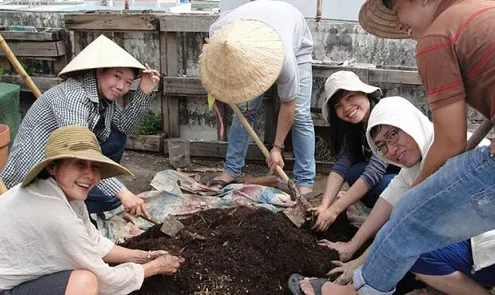
Late last month, the members had enjoyable, beneficial urban farming experiences at Saigon Garden, which is located on the rooftop of the Saigontourist Hotel in Tan Binh District, Ho Chi Minh City.

Apart from seeing for themselves organic planting methods, the youths also adopted the model at their own homes.

Nguyen Le Toan, who loves gardening, shared the experiences taught him how to safely grow aromatic herbs and fruits on his home’s terrace.

They also took great delight in learning how to process food leftovers, such as turning remaining rice into mouth-watering fried rice, or leftover chunks of chicken into sizzling porridge.

“Discarded leftovers account for up to 30 percent of the total amount of food which we buy and spend time processing, while we can easily make use of them,” the members said.

They also learn to make the best of natural, environmentally- and people-friendly detergents such as lemons, salt and coconut oil to wipe out stains instead of using conventional chemical products.

The members are also interested in whether turning off their bike engine while waiting for red lights to turn green is beneficial regarding energy conservation and emission cut, among other various traffic issues.

Nguyen My, director of MMSoft, said she will coordinate with the social network “Song Xanh” to build a green corporate culture and lifestyle.

MMSoft is an IT consulting company where several of GetGreen Vietnam’s sessions were held.

Bui Viet Ha, chair of “Song Xanh,” revealed that after the GetGreen Vietnam project ends in April 2015, his social network will continue what the project is doing now.

Source: Talkvietnam.com

Sustainable Pangasius supply chain in Vietnam

The EU co-funded project (SUPA) has being implemented by Vietnam Cleaner Production Centre (VNCPC), along with project’s partners: WWF Vietnam, WWF Austria and Vietnam Association of Seafood Exporters and Producers (VASEP), aimed to promote sustainable and environmentally friendly Pangasius production in Viet Nam.

The participation of SUPA project in Vietfish fair 2014 and Vietnam Pangasius Forum

The EU co-funded “Establishing a Sustainable Pangasius Supply Chain in Viet Nam (SUPA)” has being implemented by Vietnam Cleaner Production Centre (VNCPC), along with project’s partners: WWF Vietnam, WWF Austria and Vietnam Association of Seafood Exporters and Producers (VASEP), aimed to promote sustainable and environmentally friendly Pangasius production in Viet Nam.

From 6th to 8th August 2014, SUPA project has participated in Vietnam Fisheries International Exhibition (Vietfish 2014) and its booth broadcast the information regarding activities and outcomes of the project to enterprises in the pangasius supply chain. On the day before, the 5th August, SUPA project also hosted a tour of the pangasius farming area in Ben Tre province and processing facility in Godaco Seafood Company located in My Tho Industrial Park, Tien Giang province. The visitors included European importers, retailers together with representatives for local and international media and ASC certificates. In addition, there was presentation of big importer companies in Brazil, Kazakhstan, etc.

V1The meeting between importer-visitors and the Godaco company  V2Visiting the processing site in Godaco company

During the tour, the importers were highly appreciated the quality and production’s scale in order to meet the standards for exporting. What being observed from this field trip was far from the imagine the importers obtained from the broadcast media in Europe and South America.

 V3Exhibition booth of SUPA project in Vietfish 2014 V4Mr Hoang Thanh (Programme Officer of European Union in Vietnam) and Ms Esther Luiten (Manager Commercial Marketing of ASC), visited the exhibition booth of SUPA project

In this event of Vietfish 2014, SUPA project joined together with VASEP to organize Vietnam Pangasius Forum, titled:” Towards sustainable growth for pangasius in Europe” and its presentations on Vietnam Pangasius market with challenges and difficulties by speakers from Directorate of Fisheries (Ministry of Agricultural and Rural Development), Ministry of Industry and Trade, SUPA project, ANOVA Seafood company (the Netherlands) and ASC certification organization.

V5Speakers at the Forum  V6Representatives at the Forum

The Forum was attended by more than 200 representatives, which included nearly 100 representatives from 80 Pangasius producing and processing companies, representatives for local policy management authorities in Mekong river delta, certification organizations, importers from Europe, South America and North America, etc. At the Forum, there were numerous questions and concerns for importing markets, especially European market as well as necessary standards for importing and exporting.

Through the success of Vietfish fair 2014, SUPA project partners will join together to organize the Annual Forum in order to build a channel of exchange information for producers, importers and experts, policy makers with the aim of a sustainable and prosper Vietnam Pangasius development.

VNCPC admin